Skip to content
Engaze

Engineering teams and product companies

Your engineers, shipping with agents by Friday.

Agentic AI training on your own codebase, your repo set up so the agents produce reviewable work, and an extra pair of hands for the builds you cannot staff.

  • AI-ready team
  • AI that does the work
  • Custom software
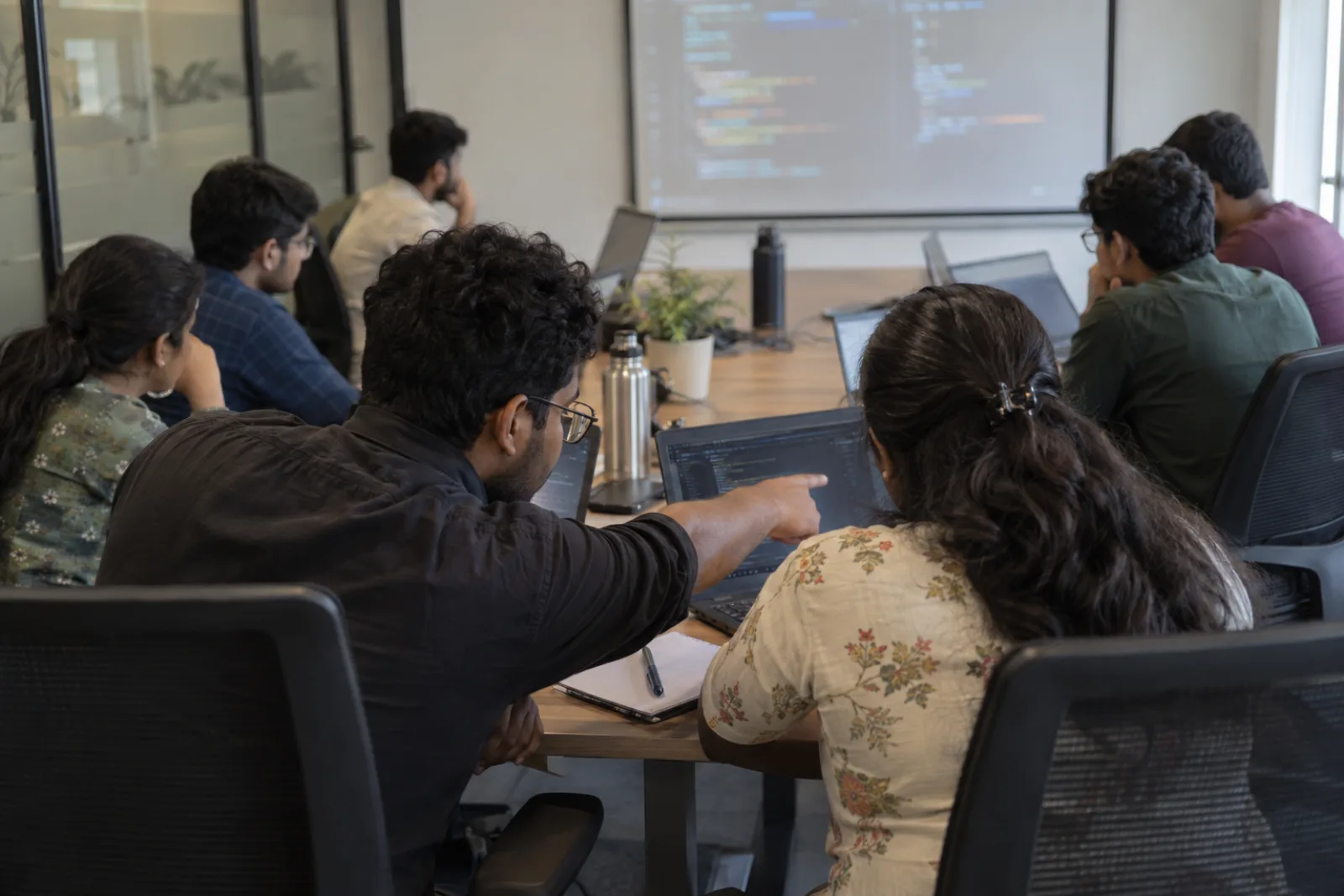
Engineers at laptops in a training room, one pointing at a colleague's screen, code on the projector (illustrative photo)

What usually hurts

  • The team pays for AI seats and gets autocomplete, plus pull requests nobody wants to review.

  • Nobody has written down how the agents should work in this repo, so every engineer prompts from scratch.

  • Features that are a week's work with agents are still quoted as a quarter.

  • Support tickets wait for the one engineer who knows that part of the code.

The flow we build around

From seats to shipped work

  1. Day 1

    Today

    Everyone uses the tool differently.

    After

    A full day on your codebase: context, skills, hooks, parallel agents, review at speed.

  2. Repo

    Today

    No rules; the agent guesses.

    After

    Your rules, worktrees and checks written into the repo so agents produce reviewable PRs.

  3. Ship

    Today

    A toy demo.

    After

    One real feature shipped through the agentic workflow before the engagement ends.

  4. Support

    Today

    Tickets queue for a person.

    After

    Tickets investigated by an agent on your machine; a person approves the fix.

  5. Keep

    Today

    Habits fade in a month.

    After

    A monthly review of what the team shipped with agents, and what to change.

What we typically build

  • Agentic AI training

    Half a day to two days, on your own code, for the whole engineering team.

  • Repo enablement

    Project context, rules, hooks, skills and worktree workflow set up and documented.

  • Overflow builds

    A feature, an integration or an internal tool built by us when you cannot staff it.

  • AI support desk

    Tickets investigated and fixed by agents, with a human approval gate.

  • Monthly review

    What shipped with agents, what did not, and the next changes.

What it looks like when it works

Real engagements, told by sector.

All the work
  • A 25-engineer product team

    Before: AI as autocompleteAfter: Agents on real tickets

    by the end of one day

    A full-day agentic AI training on the team's own codebase, not a toy repo: project context, skills and hooks, parallel agents on real tickets, and how to review AI-written code at speed. Every engineer shipped a working change through an agentic workflow before leaving.

    First working version: One day

    Read the story

    A full-day agentic AI training on the team's own codebase, not a toy repo: project context, skills and hooks, parallel agents on real tickets, and how to review AI-written code at speed. Every engineer shipped a working change through an agentic workflow before leaving.

    First working version: One day

  • Our own products

    Before: Tickets waitAfter: Reviewed fixes

    every ticket tracked until closed

    Support tickets from our products land in one dashboard. An agent on our own machine investigates, runs the checks and opens a pull request; a person approves before anything ships. Nothing is lost and nothing deploys without a human.

    Read the story

    Support tickets from our products land in one dashboard. An agent on our own machine investigates, runs the checks and opens a pull request; a person approves before anything ships. Nothing is lost and nothing deploys without a human.

Security

Your data, where you can point at it.

Agents run on your machines or your runners, with your keys. Your source code stays in your repos; we work in a worktree you can revoke. No code is used to train anything.

  • Inside your office
  • In your own cloud account
  • Hosted by us

Inside your office, in your own cloud account, or hosted by us with hourly backups and a weekly restore test. Every ticket tracked until it is closed.

How we keep systems safe

What the first month usually ships

Week 1Weeks 2–3Week 4
  1. Week 1

    the training day, then the repo set up so the habits stick.

  2. Weeks 2–3

    one real feature shipped through the new workflow, paired with your team.

  3. Week 4

    the support-ticket workflow switched on in shadow mode; the first review.

Questions

Which tools do you train on?

Claude Code first, because it is what we ship with every day; Codex and Cursor where the team uses them. The method transfers; the tool matters less than the setup.

Our code is confidential.

Training happens on your machines and your repos. We do not take code away, and the agents run under your accounts.

How many people per session?

Up to about 25 engineers for a hands-on day. Larger teams run in two groups.

How a month works

A month here ships what used to take a quarter.

Method, pricing and terms

1 month

₹5,00,000

₹23,800

per working day

The MVP: a business system with a dozen or more modules on your data, in production.

One month is 21 working days, Monday to Friday. Prices are in INR and exclude taxes.

A real example and the day rate

A real example: A factory ERP: production logs, stores, QC, dispatch, Tally posting and the owner's dashboard.

That is the month divided by its 21 days. Compare it with the cost of the hours your own people spend on the work the system replaces.

Tell us what needs solving.

Three minutes, four questions. You will hear from Prerak himself, usually within a working day.

Start a project